
Business
We turn technology born from research into products that can be used in the field.
beacon
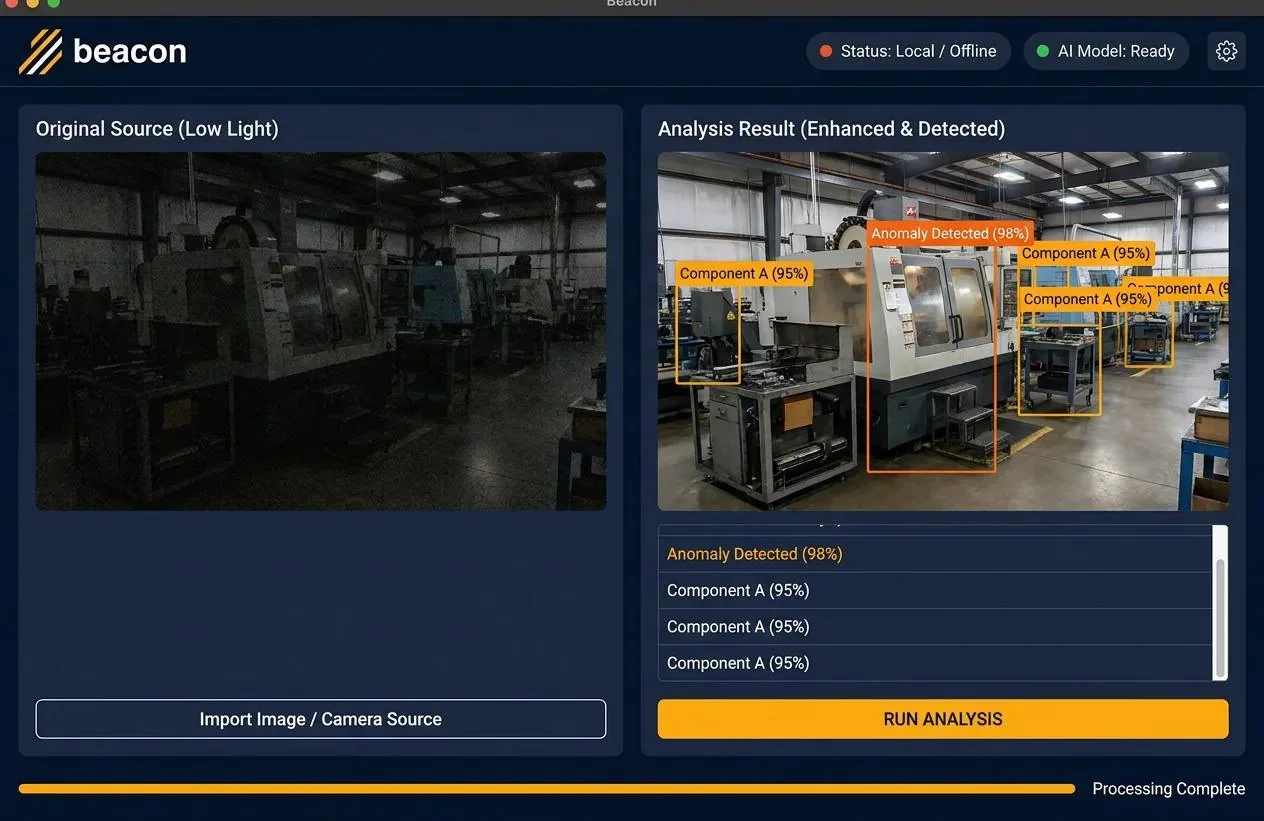
Fully offline edge AI that supports inspection in dark places.
Problem
Inspection in dark places still relies largely on the human eye. An overlooked anomaly or sign of deterioration can lead to a serious accident or an occupational injury. Because sending images to the cloud carries a risk of information leaks, the introduction of AI has been avoided.
How it works
Low-light image enhancement makes dark images visible, and object detection catches anomalies automatically. Combined with a local LLM, it does all the processing without communicating with the outside. No special equipment is needed. It is installed and used on a single existing PC in the field.
- Image and instruction input A low-light image and a natural-language prompt are entered at the same time.
- Autonomous parallel processing Image enhancement and object detection run at the same time.
- Display of results The results are shown on the screen in near real time.
Current status
Development is under way toward a PoC (proof of concept) at manufacturing sites.
Awards
- NICT Award, Tongali Business Plan Contest 2026
- Supporter Award: JR Central Award, Tongali Business Plan Contest 2026
- Supporter Award: Beyond Next Ventures Award, Tongali Business Plan Contest 2026
- Tongali Award, 5th place, Tongali Business Plan Contest 2026
June 2026. Entry title: “Beacon: A Proposal for a Fully Closed-Network Edge AI System Using Low-Light Image Enhancement and a Local LLM”
 kyudo ai
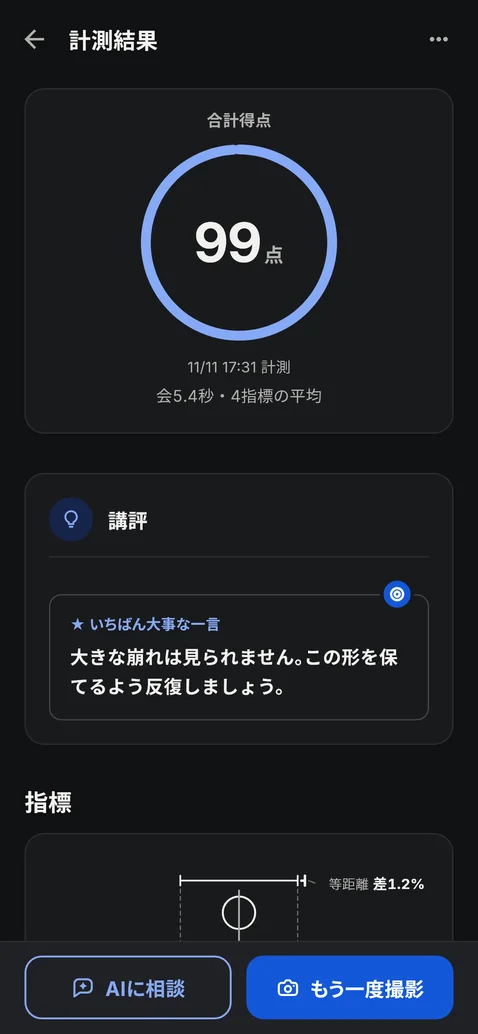
Just stand your phone up and shoot. An app that scores shooting form in kyudo (Japanese archery) on the spot.
Problem
About 65,000 high school students practice kyudo, the most of any martial arts club activity. In the field, however, time for instruction, instructors’ eyes and people to take on the role of instructor are all in short supply. Advice on kai (the full draw), which lasts a few seconds, cannot be given in time on the spot.
Source: All Japan High School Athletic Federation (fiscal year 2022)
How it works
On the device, ML Kit Pose Detection estimates the skeleton, and the posture during kai is scored on four metrics: equidistance and sanju-jumonji (the three crosses: shoulders, hips, feet). Lengths are expressed as ratios between distances and tilts as angles, so the design is not easily affected by resolution or filming distance. Video does not leave the device. Hit records, AI consultation and club messages (announcements, schedule and attendance, and consultation with instructors) are also brought together in the same app.
- Set it up and film Stand the phone upright in portrait orientation and place it 3–5 m directly in front of the archer, at chest height.
- Automatic kai detection When the archer enters kai, measurement starts automatically and the seconds until hanare (the release) are recorded.
- Scoring and feedback Sanju-jumonji and equidistance are scored out of 100, and the points to correct are shown.
Current status
In development and field trials (before store release). Calibration with video filmed of the bow actually being drawn is still to come. We are looking for schools and dojos that can take part in the field trials.
Awards
- Outstanding Presentation Award, 2025 Shikoku-section Joint Convention of the Institutes of Electrical and Related Engineers (September 2025)
- 3rd place, Youth Pitch Contest, Startup World Cup Kyushu Regional (October 2026, Toma Okugawa and Shoei Nishimura)
Research foundation
At the center of Beacon is the research on low-light image enhancement pursued by Toma Okugawa, the company’s representative. Okugawa proposed XCR, a high-speed, structure-preserving Retinex method based on a complex exponential kernel, and then published its successor, SD-Retinex, a stable method that requires no training. The SD-Retinex paper reports a PSNR of 16.47 dB and a processing time of 18.4 ms per image, under the conditions of the LOL dataset (eval15) and a CPU (AMD Ryzen 7 8840U).
Other business areas
In addition to product development, the articles of incorporation set out the following business.
- Planning, production, sale and operation of courses, training and teaching materials for programming education and entrepreneurship education
- Consulting on management and information technology, and contract research and development